Build-Operate-Transfer: The Smart Expansion Strategy for Global Business Growth

How the Build-Operate-Transfer Model Helps Companies Scale Globally with Control, Confidence, and Long-Term Value
Global expansion is exciting. It opens new markets, new talent pools, and new growth opportunities. But it also brings risk, complexity, and operational pressure. This is exactly why many modern enterprises are turning to the Build-Operate-Transfer model.
In simple terms, Build-Operate-Transfer is a structured approach where a trusted partner builds and manages a new business operation—often in another country—and later transfers full ownership to the company. It combines the flexibility of outsourcing with the control of a captive setup.
Today, companies use the Build-Operate-Transfer model to set up offshore development center teams, launch global capability center operations, and accelerate international expansion without taking unnecessary risks. It is not just a trend. It is a strategic business expansion strategy designed for long-term operational control.
Let’s explore how it works and why it is becoming the preferred model for scaling global teams.

What is Build-Operate-Transfer?
The Build Operate Transfer model, often referred to as the BOT model, is a structured approach to setting up new business operations in a foreign market.
It works in three phases:
Build – A partner establishes the infrastructure, hires talent, sets up compliance, and builds the operational foundation.
Operate – The partner runs and manages the operations to ensure stability and performance.
Transfer – Ownership and control are transferred to the client company.
Unlike a traditional outsourcing model, the goal is not permanent vendor dependency. Instead, the focus is on building a fully functional operation that eventually becomes your own captive center setup.
This model is especially popular for:
Offshore development center creation
Technology center setup
Global capability center expansion
India GCC model implementation
It offers a smart balance between speed and control.
How the Build-Operate-Transfer Model Works
Understanding the BOT model in business becomes easier when you look at it step by step.
1. Build Phase
This is where everything starts.
The implementation partner:
Identifies office space
Sets up legal entities
Handles compliance and local regulations
Recruits skilled talent
Establishes HR, payroll, and IT systems
For example, a U.S.-based SaaS company wanting to expand into India may use the India GCC model through Build-Operate-Transfer to quickly create a high-quality tech team.
The biggest advantage? You avoid the early-stage complexity of entering a new market alone.
2. Operate Phase
Once the team is built, the partner manages daily operations.
This includes:
Performance management
Process optimization
Governance structure
Reporting and compliance
Cultural integration
This phase ensures the operation is stable, efficient, and aligned with your global standards. It also acts as a strong risk mitigation strategy because experienced local experts handle operational challenges.
3. Transfer Phase
After the agreed timeline—usually 18 to 36 months—the complete operation is transferred to you.
You gain:
Full ownership
Direct control
Long-term operational control
Established workforce and systems
At this point, the operation becomes your global capability center or offshore development center.
Key Benefits of the Build-Operate-Transfer Model
Why are enterprises choosing this strategic partnership model?
Let’s break down the key advantages.
Faster Market Entry
Entering a new country can take months if done independently. With a structured BOT model in business, you leverage an expert partner’s experience and infrastructure to accelerate setup.
Lower Initial Risk
Global expansion always carries financial and regulatory risks. Build-Operate-Transfer reduces exposure during early stages.
You do not need to:
Invest heavily upfront
Navigate unknown labor laws alone
Build local networks from scratch
This makes it an effective risk mitigation strategy.
Access to Top Talent
Countries like India offer deep technical expertise. The India GCC model has become a preferred choice for technology center setup because of strong talent availability.
The right partner helps attract and retain high-quality professionals while aligning them with your company culture.
Seamless Transition
Transition management is one of the most sensitive phases. In the BOT model, transfer planning is built into the agreement from day one. This ensures no disruption when ownership changes hands.
Long-Term Value Creation
Unlike pure outsourcing, Build-Operate-Transfer creates a long-term asset for your business. After transfer, you fully own the team, systems, and processes.
Why Companies Choose Build-Operate-Transfer for GCC Setup
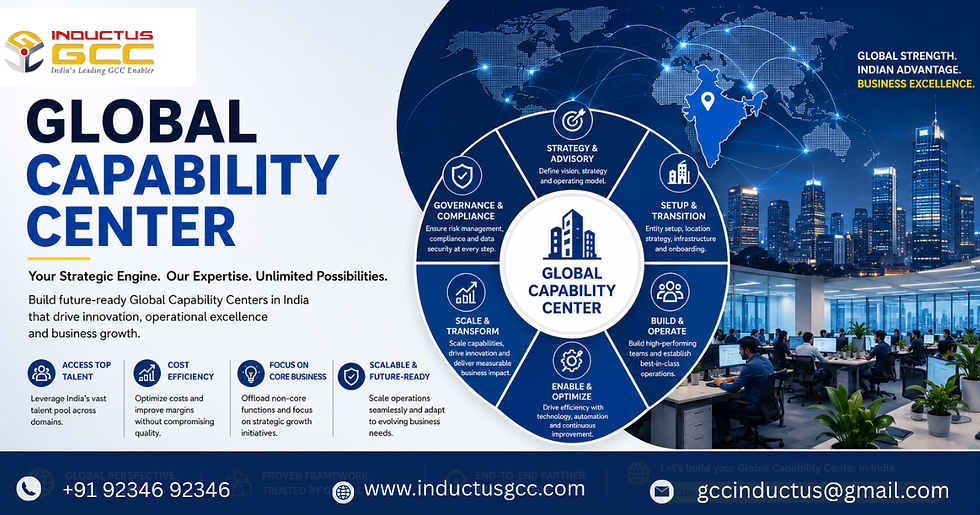
A global capability center is more than just an offshore office. It is a strategic extension of your headquarters.
Companies prefer Build-Operate-Transfer for GCC setup because:
It allows structured growth
It ensures quality control
It aligns with long-term strategy
It supports scaling global teams
The global capability center model has evolved. Today’s GCCs handle:
Product engineering
R&D
Data analytics
Cybersecurity
AI and automation
Using the Build Operate Transfer model ensures the GCC is not just operational but future-ready.
Build-Operate-Transfer vs Traditional Outsourcing
Many leaders confuse Build-Operate-Transfer with outsourcing. But the difference is significant.
Outsourcing Model
Vendor retains ownership
Limited visibility into internal processes
Long-term dependency
Less cultural integration
Build-Operate-Transfer Model
You gain ownership
Structured knowledge transfer
Aligned with long-term operational control
Becomes your captive center setup
If your goal is temporary cost reduction, outsourcing may work. But if your aim is strategic expansion, Build-Operate-Transfer is a smarter choice.
Risk Management in the Build-Operate-Transfer Model
Every international expansion comes with challenges:
Regulatory compliance
Hiring risks
Infrastructure delays
Cultural differences
Financial unpredictability
A well-designed BOT model addresses these risks through:
Strong governance frameworks
Clear SLAs
Defined transfer timelines
Transparent financial structures
Legal clarity from the start
The build phase absorbs uncertainty. The operate phase stabilizes performance. The transfer phase ensures ownership continuity.
That structured progression makes Build-Operate-Transfer one of the most reliable expansion frameworks available today.
How to Successfully Implement a Build-Operate-Transfer Strategy
A successful Build-Operate-Transfer journey requires planning and alignment.
Here are key steps:
Define Clear Objectives
Are you building a technology center setup? A product engineering team? A global capability center? Clarity drives structure.
Choose the Right Location
India remains a top destination due to its strong talent ecosystem and cost advantages. The India GCC model has proven highly successful across industries.
Select an Experienced Partner
Your partner should have:
Local expertise
Strong recruitment capabilities
Compliance knowledge
Proven transition management experience
Plan the Transfer Early
The transfer phase should not be an afterthought. Define metrics, timelines, and ownership structures from day one.
Focus on Culture Integration
Scaling global teams requires cultural alignment. Even during the operate phase, employees should feel connected to your brand and leadership.
Role of Partners Like Inductusgcc in BOT Success
Execution makes the difference between success and struggle.
This is where experienced enablers such as Inductusgcc play a vital role. As a specialized GccEnabler, Inductus supports companies through structured GCC setup and Build-Operate-Transfer journeys.
Organizations working with Inductus benefit from:
End-to-end infrastructure setup
Talent acquisition expertise
Governance and compliance management
Seamless transfer frameworks
The Inductusgcc enabler approach focuses on building long-term assets rather than temporary outsourcing arrangements. By combining local knowledge with global standards, Inductus helps businesses create scalable and sustainable offshore development center operations.
In many cases, companies entering the India GCC model rely on partners like Inductus to simplify complexity and ensure smooth transition management.
Real-World Example: Scaling Through Build-Operate-Transfer
Imagine a European fintech company aiming to expand its engineering team.
Instead of directly investing millions into a new subsidiary, it uses the Build-Operate-Transfer model.
Phase 1: A partner builds the India-based offshore development center. Phase 2: The partner manages hiring, compliance, payroll, and operations. Phase 3: After two years of stable growth, full ownership is transferred.
Result?
A fully operational 150-member tech team
Reduced setup risk
Strong local leadership
Long-term cost efficiency
Full strategic control
That is the power of Build-Operate-Transfer in action.
When is Build-Operate-Transfer the Right Choice?
This model works best when:
You want long-term presence in a new market
You plan to scale aggressively
You want ownership, not vendor dependency
You seek structured global expansion
You want a balanced risk mitigation strategy
It may not be ideal for short-term projects. But for strategic international growth, it is highly effective.
The Future of Global Expansion and the BOT Model
As global competition intensifies, companies need flexibility and control at the same time.
The Build-Operate-Transfer model delivers both.
With increasing demand for global capability center networks and digital transformation hubs, the BOT model in business is becoming central to modern expansion strategies.
It allows companies to:
Enter new markets confidently
Access global talent
Maintain governance standards
Transition to full ownership smoothly
In a world where agility matters, Build-Operate-Transfer offers structured adaptability.
Conclusion: Why Build-Operate-Transfer is a Long-Term Growth Engine
Global expansion is no longer optional. It is a necessity for competitive growth. But how you expand determines whether you scale successfully or struggle with operational challenges.
Build-Operate-Transfer stands out as a powerful business expansion strategy because it balances speed, risk management, and long-term operational control. It combines the flexibility of an outsourcing model with the ownership benefits of a captive center setup.
From offshore development center creation to full-scale global capability center establishment, the model offers a structured pathway to sustainable growth. The India GCC model continues to demonstrate how effective this approach can be when executed properly.
With experienced partners like Inductusgcc guiding the journey, businesses can confidently build, operate, and transfer high-performing global operations without unnecessary risk. The structured support provided by Inductus and its GccEnabler expertise ensures that transition management is smooth and ownership is seamless.
In the coming years, companies that prioritize strategic partnership models over traditional vendor arrangements will gain a competitive edge. Build-Operate-Transfer is not just an operational framework—it is a long-term investment in global strength.
If your organization is planning international expansion, now is the time to consider how Build-Operate-Transfer can shape your next growth chapter.
Comments