Global Capability Center: From Back Office to Innovation Hub

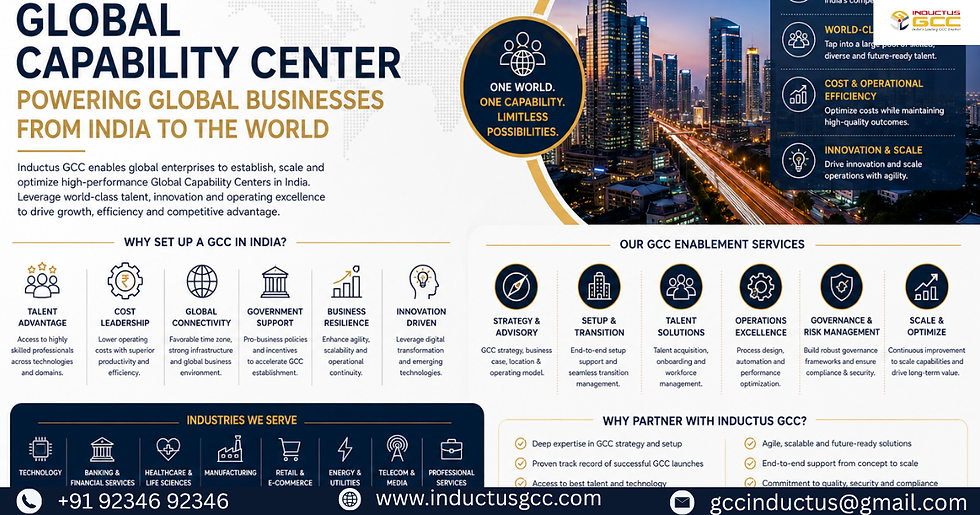
A Global Capability Center, or GCC, used to be easy to describe. It was a company’s offshore unit that handled work headquarters wanted done at lower cost. Finance processing, IT support and customer queries were typical.
That description no longer fits. Today’s GCCs build products, run research, secure networks and apply artificial intelligence. Understanding that shift matters if you are planning a center, because the purpose you set at the start shapes every decision that follows.
What a GCC Is
A Global Capability Center is a unit owned by a multinational company, located in another country, that delivers services or capabilities to the parent organization. Because the parent owns it, the company keeps direct control over operations and intellectual property. That is the main difference from traditional outsourcing, where a third party delivers work under a contract.
In practice, a GCC can take several forms. It might be a shared service center for finance, HR, IT and procurement. It might be an R&D center, a knowledge center, an innovation center or a customer service center. Many companies run more than one of these roles under one roof.
Why India Became the Center of the GCC World
India hosts more than half of the world’s GCCs. Inductus puts the number of centers above 1,800 and the market size above $46 billion, drawing on a talent pool of millions of professionals, cost-effective operations and strong technology infrastructure. The same sources project that the market could cross $110 billion by 2030.
Those numbers are the result of a change in motive. Early centers were built to save money. Many of today’s centers are built to access skills and to speed up innovation.
How the GCC Role Has Changed
Inductus describes the evolution as a move from cost-saving back offices to innovation-led R&D hubs working on AI and cybersecurity. Its series of “GCC 3.0” reports for the UK, Germany and the US applies this view to specific home markets. Without getting lost in labels, the change can be read in three shifts.
From tasks to ownership
A center that once followed instructions now owns outcomes. A team that processed transactions now runs a whole function, and a development group that once coded to specification now owns a product area.
From cost to capability
The question changes from “how much cheaper is this?” to “what can we do here that we cannot do elsewhere?” Access to a large STEM workforce lets companies build capabilities, such as advanced analytics and product engineering, that would be hard to staff at home.
From support to strategy
Centers that began as support units now contribute to strategy. They spot trends, test new practices and influence how the wider company operates. The steps Inductus lists for setting up a GCC reflect this: a center that starts as a process hub can grow into a center for innovation.
What AI Adds to the Picture
Artificial intelligence is changing the work that centers do and the skills they need. Inductus has published research on how AI is rewriting the GCC rulebook, alongside material on building a future-ready workforce and leadership.
For a company planning a center, two points follow.
Role design. Some work that used to justify large teams can now be automated. Centers that plan only for volume may find their purpose shrinking, while those that plan for capability keep growing.
Talent. Demand is rising for engineering, data and security skills. Hiring and retention plans need to reflect that, with flexible working arrangements and HR practices that attract and keep specialists.
Defining Your Center’s Purpose Today
Given this evolution, the first decision is not where to build or whom to hire. It is what the center is for. A useful way to settle this is to answer four questions in writing.
What should the center own? A process, a function, a product or a research area.
What can it do that headquarters cannot? Access to skills, speed of hiring or round-the-clock coverage.
How will its role grow? Decide now what a successful center looks like in three to five years.
How will it stay connected? Align the center with the parent company’s vision and keep the culture consistent across both.
Your answers point to the type of center that fits: shared services for consolidation, R&D for new products, knowledge for expertise, innovation for experimentation, or customer service for client-facing work.
Setting Up With the End Goal in Mind
The practical steps are well established. Define your vision, standardize standard operating procedures for hiring, procurement and payments, complete the legal paperwork such as the Memorandum of Association, Articles of Association and Director Identification Numbers, choose the right location, hire flexibly and plan for growth.
What the evolution of the GCC adds is sequence. Plan for growth early. If you design a center only for today’s tasks, you will have to redesign it when its role expands. If you plan the legal structure, location and talent strategy with a larger mandate in mind, you can expand without starting again.
Choosing How to Own and Operate It
The ownership model also affects how a center evolves. Inductus works with three:
BOT (Build-Operate-Transfer): the partner builds and runs the center, then transfers full ownership to you.
COPO (Company-Owned, Partner-Operated): you own the center and the partner operates it, with no capital expenditure on your side.
FLEXI: a customized, on-demand arrangement with no rigid commitments, which can scale as needs change.
A center may start in one model and move to another as its role grows.
The Takeaway
The Global Capability Center is no longer a back office. It is a way to access skills, build capabilities and shape strategy. The companies that benefit most are those that define a clear purpose, plan for growth from day one and choose structures that can change with the center.
Planning your Global Capability Center? Talk to the Inductus GCC team about a purpose-led plan for your center.
Comments