Why India's Tech Revolution Is Powered by Global Capability Centers in 2026

Introduction: The Tech Megatrend You Can't Ignore

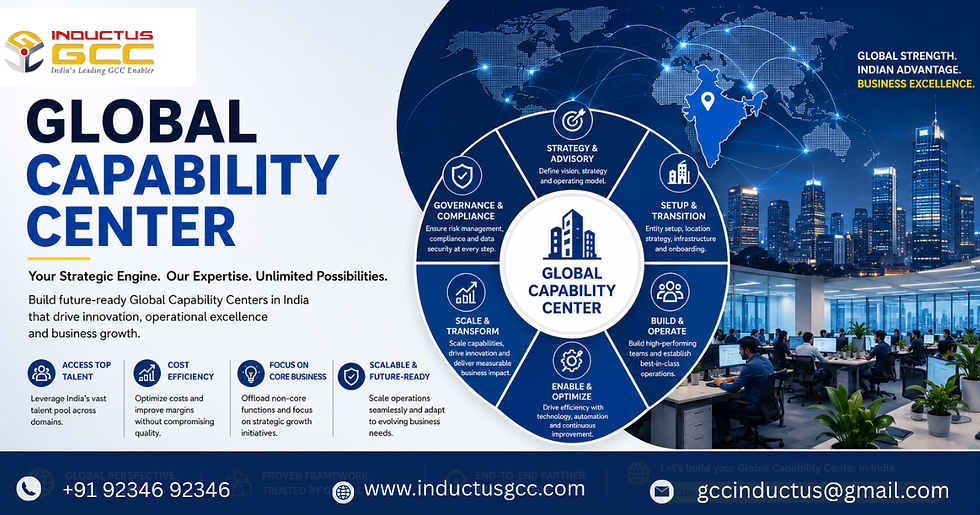
The global technology landscape is witnessing a seismic shift. While Silicon Valley still commands attention, the real engine of enterprise innovation is quietly humming thousands of miles away — in India. At the heart of this transformation are Global Capability Centers (GCCs): dedicated offshore units that global enterprises use to harness India's unmatched talent, cost efficiencies, and digital infrastructure.
According to Forbes India, roughly 60% of the top 500 global companies have already set up GCCs in India, a statistic that underscores just how central India has become to global enterprise strategy. And with the market already surpassing $46 billion, this is no passing trend — it is a full-scale structural revolution.
Leading this charge is Inductus GCC, India's premier GCC enabler, helping global enterprises of all sizes design, build, and operate world-class capability centers from the ground up.
What Exactly Is a Global Capability Center?
A Global Capability Center — also known as a GIC (Global In-house Center) or captive center — is an offshore unit established by a multinational corporation to handle a defined scope of operations. Unlike traditional outsourcing, where a third party controls the work, a GCC is fully owned and directed by the parent company.
Modern GCCs go far beyond the back-office functions of the past. Today, they are innovation powerhouses responsible for:
Artificial Intelligence & Machine Learning development
Cybersecurity operations and threat intelligence
Product engineering and R&D
Advanced data analytics and business intelligence
Finance, legal, and HR process management
Customer experience and digital transformation initiatives
Inductus GCC outlines five core types of capability centers on their platform: Shared Service Centers, R&D Centers, Knowledge Centers, Innovation Centers, and Customer Service Centers — each designed to serve a distinct strategic function. Explore the full model breakdown on the Inductus GCC homepage.
India: The Undisputed Global Leader for GCCs
India's dominance in the GCC ecosystem is not accidental — it is the result of decades of deliberate investment in education, digital infrastructure, and business policy. Here is why global enterprises continue to choose India:
1. Unparalleled Talent Pool
India produces over 1.5 million engineering graduates annually, alongside a vast pool of finance, legal, analytics, and management professionals. According to NASSCOM, 1 in 10 analytics professionals worldwide is Indian — a statistic that makes India the default destination for knowledge-intensive GCC functions.
2. Significant Cost Advantages
Operating in India can deliver cost savings of 20%–40% compared to developed markets, per McKinsey. Office rentals in Indian tech hubs are up to 50% lower than comparable Asian cities and 60% lower than European counterparts — meaning enterprises can build bigger, better teams at a fraction of the cost.
3. Strong Government Support
The Indian government has rolled out a series of initiatives — Digital India, Startup India, and state-specific GCC policies in Tamil Nadu, Telangana, Uttar Pradesh, and Andhra Pradesh — that offer tax exemptions, plug-and-play infrastructure, and payroll subsidies to attract global enterprises.
India is also reportedly developing a comprehensive new national GCC policy. Read more on India Briefing's coverage of India's upcoming GCC policy.
4. Mature Ecosystem & World-Class Infrastructure
With over 1,800 GCCs already operational and a professional workforce exceeding 1.9 million, India offers a mature, supportive ecosystem with well-established legal frameworks, technology parks, and SEZ-based tax benefits.
The Three GCC Service Models Reshaping Global Business
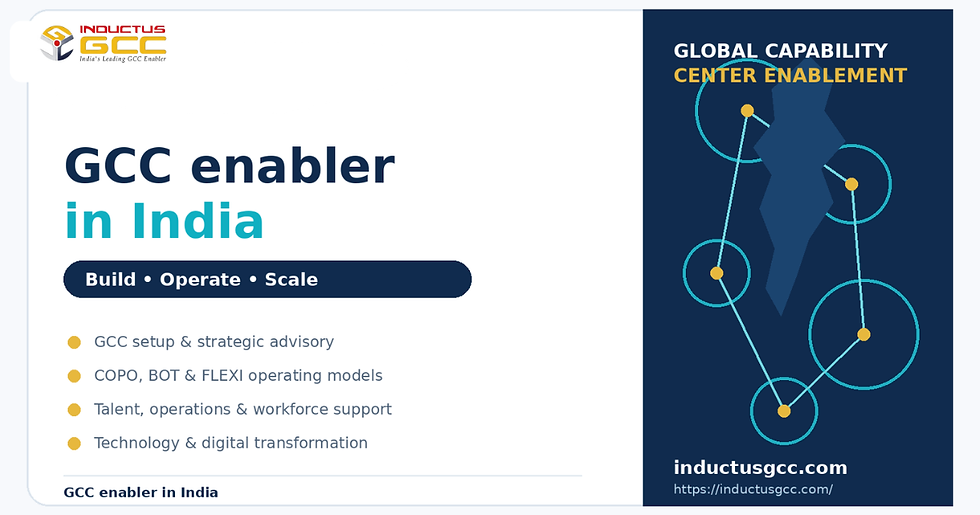
One of the most critical decisions when establishing a GCC is choosing the right operating model. Inductus GCC has pioneered three distinct service models that cater to different enterprise needs:
BOT — Build, Operate, Transfer
The BOT model is ideal for enterprises seeking full ownership with guided setup. Inductus builds and operates the GCC until it reaches optimal maturity, then transfers complete ownership to the parent company. This model minimizes risk while ensuring a high-quality, market-ready capability center.
COPO — Company-Owned, Partner-Operated
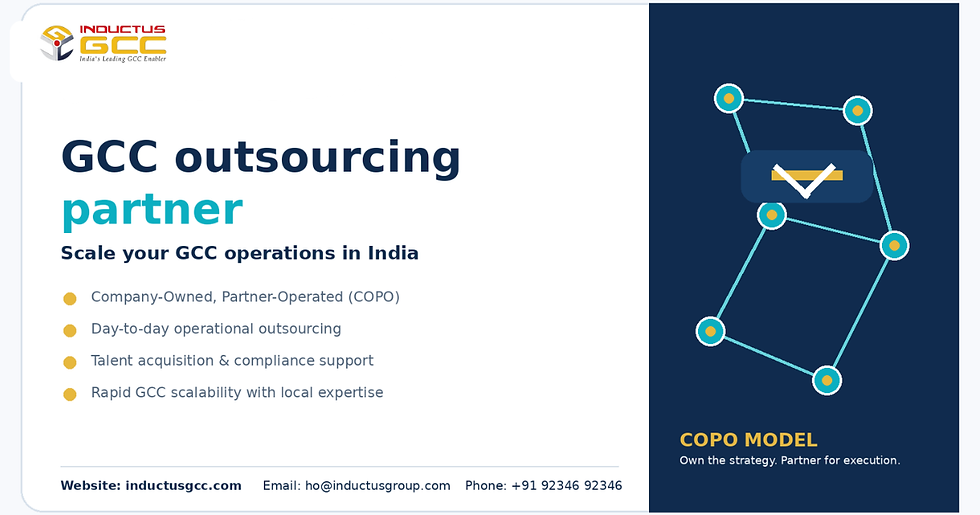
The COPO model is a groundbreaking innovation — the parent company retains 100% ownership and intellectual property, while Inductus handles all operational aspects. There is zero CapEx burden, no administrative overhead, and pre-built systems ensure rapid deployment. The Week Live reports that COPO model adoption is set to surge 25% by 2030.
FLEXI — Adaptive GCC Solutions
For high-growth startups and mid-sized enterprises, the FLEXI model offers access to niche skills and cutting-edge infrastructure on demand — with no rigid long-term commitments. Teams can be scaled up or down instantly, providing a critical competitive advantage in fast-moving markets.
The Rise of Tier 2 Cities: GCC's Next Frontier
While Bengaluru, Hyderabad, and Pune remain dominant GCC hubs, a new wave of expansion is sweeping India's Tier 2 cities. Companies like Walmart Global Tech, HCL, Cognizant, and Infosys have already established or expanded presence in cities like Bhubaneswar, Nagpur, Madurai, Lucknow, Kochi, and Trivandrum. As detailed in Inductus GCC's analysis of GCCs in Tier 2 cities, these locations offer loyal workforces, lower costs, and access to over 2 million graduates annually from regional institutions.
State governments are actively incentivizing this shift. Telangana, Uttar Pradesh, Andhra Pradesh, and Tamil Nadu now offer tax breaks, subsidies, and ready-to-use GCC facilities — making Tier 2 expansion a strategically sound and financially attractive move for global enterprises.
GCC 3.0: From Cost Center to Innovation Powerhouse
The GCC of 2026 looks nothing like its predecessor. As Inductus GCC documents in their analysis of India's GCC Revolution, these centers have evolved from basic back-office units into full-scale innovation hubs driving AI-first platforms, IP creation, and digital transformation for global enterprises.
This shift — often called GCC 3.0 — is characterized by:
Deep involvement in strategic decision-making at the global level
Creation and ownership of intellectual property
Leadership of AI, GenAI, and cloud-native product development
Building Centres of Excellence (CoEs) that serve global teams
Acting as digital twins of headquarters operations
Inductus GCC's innovative Digital Twin model takes this evolution a step further — offering real-time operational synchronization between global headquarters and the India-based GCC, eliminating time zone friction and maximizing operational efficiency.
Global Business Services: The GCC Superpower
Beyond pure tech functions, leading GCCs are now delivering end-to-end Global Business Services (GBS) — a unified operational framework that harmonizes HR, IT, procurement, and customer service across geographies. Inductus GCC's GBS framework integrates analytics, cloud, automation, and AI into a single intelligent delivery model — enabling businesses to shift from manual workflows to future-ready, scalable ecosystems.
The GBS model also comes with built-in governance frameworks — HIPAA, SOX, GDPR — ensuring that global enterprises remain compliant, audit-ready, and legally protected regardless of where they operate.
Real-World Success: What Global Enterprises Are Saying
The proof of Inductus GCC's impact lies in the results delivered to its clients:
A global enterprise reported that Inductus GCC's end-to-end service accelerated its India operations launch by several years, with professional handling of legal, infrastructure, and talent aspects.
An international technology firm credited Inductus with helping establish their GCC as a legitimate innovation hub, describing the team as 'an extension of our leadership.'
A high-growth startup highlighted the FLEXI model as a 'savior,' enabling rapid team scaling without long-term commitments.
Global companies like NVIDIA and Hitachi have also successfully leveraged India's GCC ecosystem. Watch their stories on Inductus GCC's video channel.
Also Visit : Inductus Group Website
2026 and Beyond: Why Now Is the Time to Act
India's GCC industry is projected to cross $100 billion in economic contribution by 2030, directly employing 2.5–2.8 million professionals. The window for first-mover advantage is still open — but it is narrowing.
Enterprises that establish GCCs today will benefit from:
Access to the best talent before competition intensifies
Maximum cost savings before India's operating costs gradually rise
Full alignment with AI-first, platform-based delivery models
Strong IP protection under India's evolving digital governance framework
Government incentives that are most generous in the current policy cycle
Conclusion: Your GCC Journey Starts Here
The data is clear, the global trend is undeniable, and the strategic case is compelling. Whether you are a Fortune 500 corporation looking to establish a next-generation innovation hub, or a mid-sized enterprise seeking to leverage India's talent and cost advantages, a Global Capability Center in India is no longer optional — it is essential.
With 17+ years of deep expertise, a proven three-model framework, and a reputation recognized by Forbes India, The Hindu Businessline, and Times of India, Inductus GCC is the partner of choice for enterprises ready to build their future in India.
Ready to explore your options? Download Inductus GCC's comprehensive Strategic GCC Guide or get in touch with their expert team to start your GCC journey today.
Comments