GCC Enabler in India: Moving Your Center From Cost Arbitrage to Value Arbitrage

Most companies open a Global Capability Center in India for a simple reason: the economics work. Skilled people cost less, and the talent pool is deep. That reason is enough to start, but it is not enough to sustain a center for ten years.
The centers that last are the ones whose mandate grows. They begin by running processes and end up owning products, platforms and research. That shift is less about the center and more about the partner who guides it. This article looks at the GCC enabler in India through that lens: what changes at each stage of maturity, and what your enabler must do about it.
Why the Mandate Matters More Than the Setup
India has more than 2,100 GCCs by the figure Inductus cites in its recent content. They account for over half of the world’s total and employ more than 2.4 million professionals. Revenue is above $46 billion. Inductus projects that the sector’s economic impact could reach $470–600 billion by 2040.
Numbers like these explain why companies enter India. They do not explain why some centers become strategic and others stay back offices. The difference is almost always mandate: what the center is trusted to own.
An enabler that only handles incorporation, office space and recruitment can deliver a working center. It cannot deliver a growing one. So the useful question is not “who can set this up?” but “who can take this center from where it starts to where it should end up?”
The Four Mandate Stages of a GCC
Centers tend to move through recognizable stages. Your enabler should be able to name which one you are in and what the next one demands.
Stage 1: Execution
The center runs defined processes. Work is documented, handed over from headquarters and measured on cost and accuracy. Finance operations, HR administration and support functions are typical.
At this stage, the enabler’s job is operational reliability. That means standard operating procedures, clean transition of knowledge from global teams, and compliance, audit and reporting in place from day one. Whether the unit is called a Shared Services Center or an Offshore Development Center, the early test is the same: does work move across smoothly and stay stable?
Stage 2: Ownership
The center stops following instructions and starts owning outcomes. A team that once processed invoices now owns the whole payables function. An engineering group that once built to specification now owns a module end to end.
The enabler’s job changes here. It must help with leadership hiring, because ownership needs local leaders who can make decisions. It must also help with organization design and governance, so that decision rights are clear between the center and headquarters. Many centers stall at this point because nobody redesigned the structure to match the new responsibility.
Stage 3: Specialization
The center becomes a place where particular capabilities are deepest. That could be data engineering, cloud, cybersecurity or a domain such as banking technology. Headquarters begins to route work to India because the expertise sits there, not because it is cheaper.
The enabler’s job is talent depth. This means skill mapping, targeted hiring and compensation aligned to local benchmarks. It also means technology and infrastructure that can support advanced work. The enabler should also be honest about whether your chosen city can supply the specialist talent you now need.
Stage 4: Innovation
The center originates ideas. It owns AI, product engineering and R&D mandates, and it contributes to enterprise strategy. Inductus describes this as a shift toward “value arbitrage” and frames its 2026 summit around “GCC 4.0,” covering AI scaling, cloud infrastructure and cybersecurity.
The enabler’s job at this stage is strategic. It helps you decide which innovation mandates to place in India and how the center connects to global product and research teams. It also keeps governance, legal structure and cybersecurity in step with the center’s growing responsibility.
Why Ownership Models Should Change as the Mandate Grows
The model you choose at stage one will not necessarily suit stage four. A good enabler offers more than one route and helps you move between them.
Inductus works with three ownership models:
BOT (Build-Operate-Transfer): the partner builds and runs the center, then transfers it once it is stable. This suits a company that wants speed in the early stages and full ownership later.
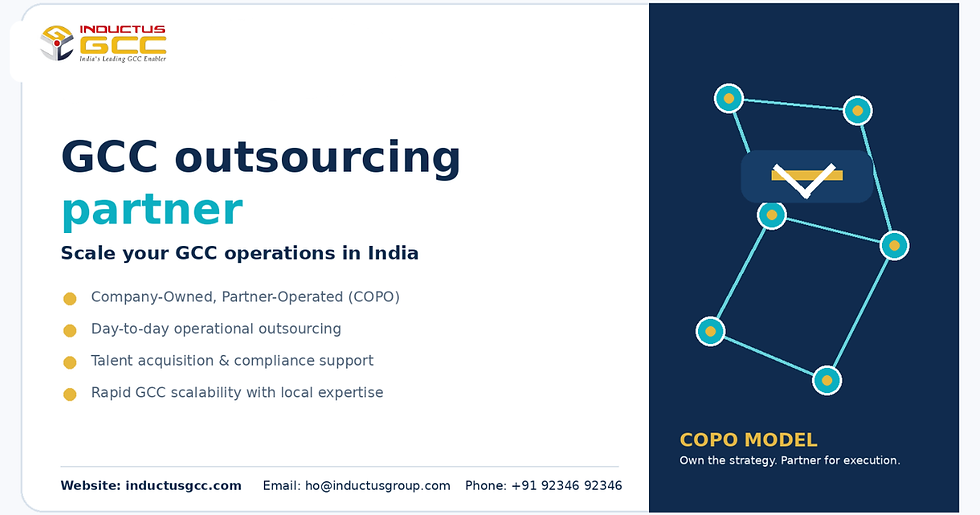
COPO (Company-Owned, Partner-Operated): you own the brand and systems, and the partner manages daily operations. This suits a center that has reached ownership and needs to scale without a large local operations team.
Flexi: a structure shaped around how the organization actually wants to work, useful when the mandate does not fit a fixed template.
The point is not to pick one forever. A center might start under BOT, move to COPO as volume grows, and adopt a Flexi structure when a specialized unit is added. If your enabler offers only one model, that flexibility is not available to you.
What a Digital Twin Changes
Time zones are a quiet drag on mandate growth. A center that works hours apart from headquarters often stays in an execution role simply because collaboration is hard.
Inductus addresses this with Digital Twin integration, described as real-time operational sync without time-zone lag. For a center moving toward ownership and innovation, this matters. Product and research work needs close coordination, not batch handovers. When you assess an enabler, ask how it keeps the center and headquarters working as one team once the work becomes collaborative.
Questions to Ask Your Enabler About the Road Ahead
Use these in your evaluation. Each one tests whether the partner thinks beyond setup.
Which stage would you place our center in today, and what would move us to the next one? A good answer is specific to your functions, not generic.
How will governance change as we take on more ownership? Look for decision rights, reporting lines and audit mechanisms that evolve.
Which of our functions could realistically hold an AI, product or R&D mandate in India? This reveals whether the enabler understands the innovation stage.
How do we change ownership models later? The answer should describe a path, not a new contract negotiation from scratch.
What stays with you after go-live? Legal, technology, talent and trade support under one roof means fewer handoffs as the center grows.
Where Inductus Fits
Inductus has worked on GCC and consulting engagements since 2007 and serves more than 300 clients. It has over 1,500 professionals and a presence across the USA, the UK, the UAE, Germany, Japan, South Korea, Australia and Luxembourg. Its approach covers strategy and feasibility, legal entity setup and compliance, talent and workforce design, technology build, Digital Twin integration, and legal process and trade support, delivered through a Discover, Design, Build and Scale framework.
The relevance to mandate growth is the breadth. A center that moves from execution to innovation will need legal, technology, talent and governance support at different moments. Having those under one umbrella reduces the friction of switching providers as needs change.
The Takeaway
A GCC that only reduces cost will eventually be questioned on cost. A GCC that owns outcomes, builds expertise and originates ideas becomes difficult to do without. The enabler you choose shapes which of those you get.
Choose the partner who can describe your next stage, not just your first one.
Planning a center that grows with your business? Speak to the Inductus GCC team about a roadmap from setup to scale.
Comments