GCC Partner for Setting Up a Scalable Global Delivery Center in India: Scale Capability, Not Just Headcount

Ask most companies what “scalable” means for a global delivery center and the answer is about numbers: more seats, more hires, more work moved over. Headcount growth is easy to measure and easy to report. But a center that doubles in size while still doing the same low-complexity work has not really scaled. It has only grown.
The more valuable form of scale is capability maturity: the center takes on work that is harder, more strategic and closer to the parent company’s core. This article explains how a GCC partner can help you design a delivery center in India that scales in this sense, and what to look for when choosing one.
Two Kinds of Scale
Volume scale means handling more of the same work. Capacity increases, costs per unit often fall and the center becomes a larger version of itself.
Capability scale means doing different and better work. The center moves from executing instructions to owning outcomes, then to shaping decisions, and eventually to creating new products, platforms or methods for the wider organization.
Both matter, but they require different planning. Volume scale depends on hiring and process discipline. Capability scale depends on leadership, trust, knowledge and a deliberate path set from the start. A partner who only plans for the first will build you a bigger center that stays stuck at the bottom of the value chain.
The Value Ladder for a Delivery Center
India offers several types of Global Capability Center, including shared service centers, R&D centers, knowledge centers, innovation centers and customer service centers. Whatever the starting type, most successful centers move through recognizable stages of maturity.
Stage 1: Reliable Execution
The center takes over well-defined tasks with clear instructions and measurable outputs. Success means accuracy, timeliness and consistent quality. The parent company retains most decisions and design responsibility.
At this stage, the partner’s role is to build strong foundations: standardized procedures, a stable team, reliable tools and transparent reporting. Trust is earned through predictability.
Stage 2: Process Ownership
Once execution is dependable, the center begins to own entire processes, not just individual tasks. It manages end-to-end flow, resolves exceptions, suggests improvements and takes responsibility for results.
This requires different capabilities: stronger subject-matter expertise, authority to decide within defined limits and metrics tied to outcomes rather than activity. The partner helps by defining decision rights, training managers and setting up governance that gives the center room to act.
Stage 3: Advanced Capability
Here, the center contributes specialist skills such as analytics, engineering, cybersecurity, data science or financial planning that the parent company may find hard to build elsewhere. It becomes a source of expertise, not only capacity.
Success depends on talent depth, access to modern tools and close collaboration with parent-company teams. The partner supports this through targeted recruitment, skills development and clear links between the center and global functions.
Stage 4: Innovation and Ownership of Mandate
At the highest stage, the center originates ideas, builds products or platforms and influences strategy. It may own a global capability outright, lead a business line or run research programs.
Few centers reach this point quickly, and not every center needs to. But the ones that do tend to be those designed with this possibility from the start.
What a Capability-Focused Partner Does Differently
Designs the Mandate, Not Just the Site
A good partner asks early: what should this center be responsible for in three years, and what must be true for that to happen? The answer shapes location choice, hiring profiles, technology investment and governance. Without it, the center defaults to whatever work happens to be transferred first.
Builds Leadership Layers in Advance
Capability growth needs people who can lead beyond the current team. A partner should help plan for team leads, functional heads and senior managers before they are urgently needed, including succession and development paths. Centers that rely on a few early leaders often stall when those leaders are stretched.
Creates Knowledge Systems
Moving up the value ladder requires deep, shared knowledge. Documentation, playbooks, training programs and communities of practice turn individual expertise into institutional capability. A partner can establish these systems early, when they are easiest to embed.
Links Work Transfer to Skill Growth
Each wave of work moved to the center should be chosen partly for what it teaches. A thoughtful sequence introduces progressively more complex tasks, giving teams time to build skill and confidence. Transferring everything at once, or only low-complexity work indefinitely, limits growth.
Measures Value, Not Only Activity
Tracking seats filled and tickets closed is necessary but insufficient. Capability-focused centers also track indicators such as quality of decisions, speed of improvement, share of work that is complex, internal customer satisfaction and contribution to parent-company goals. A partner can help define these measures and build the reporting that supports them.
Governance That Allows Growth
Maturity depends on trust, and trust depends on governance. Clear structures make it easier for headquarters to hand over responsibility with confidence.
Useful elements include a joint steering group with senior sponsors from both sides, defined decision rights at each stage of maturity, regular reviews of scope and performance, and an agreed process for expanding the center’s mandate. When expansion follows a transparent process, it becomes a normal part of operations instead of a negotiation each time.
Service Models and Maturity
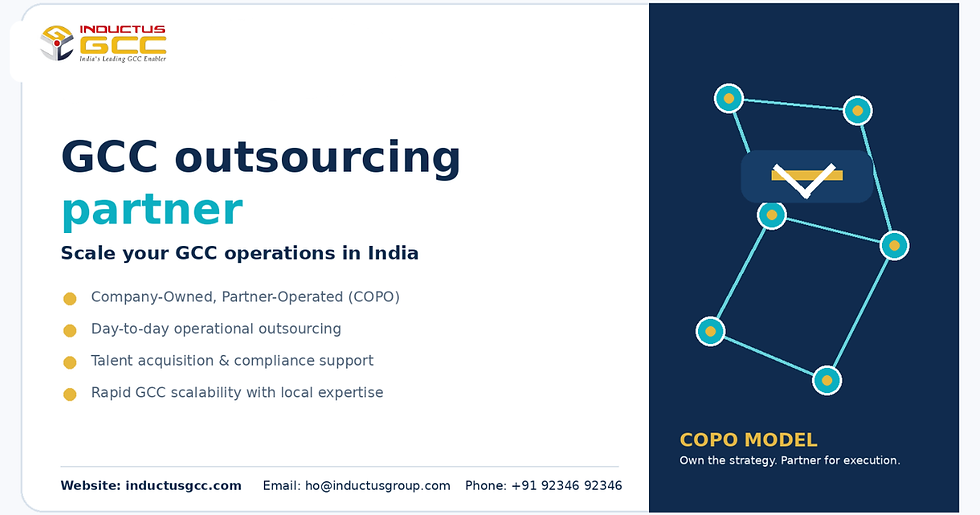
The service model you choose influences how easily the center can grow in capability. A Build-Operate-Transfer arrangement can accelerate early stages and then pass ownership to the parent company as it gains experience. A Company-Owned, Partner-Operated model keeps ownership with the client while the partner runs operations, with scope adjustable over time. A flexible model suits companies that expect to change their mix of functions and want support that adapts.
Whichever you choose, ask how the arrangement supports progression to higher-value work, and make sure contracts allow scope to expand without major renegotiation.
Pitfalls That Keep Centers Stuck
Measuring only cost. Savings matter, but if cost is the only measure, the center will be treated as a cost line forever.
Hiring only for today’s tasks. Teams selected solely for current work may lack the range to take on more.
Weak links to headquarters. Without regular contact, global teams do not see what the center can do.
Underinvesting in leadership. A thin management layer limits how much responsibility the center can absorb.
No roadmap. Without an agreed path, each expansion becomes an ad hoc decision.
Questions to Ask a Prospective Partner
How do you help clients define a three-to-five-year mandate for the center?
Can you show examples of centers that moved from execution to ownership or innovation?
How do you plan leadership development and succession?
What measures do you recommend beyond cost and headcount?
How does your engagement model handle growth in scope?
Who stays involved after the initial setup?
Conclusion
A scalable global delivery center in India is not simply a large one. It is a center that can take on harder, more valuable work as trust and skill grow. A GCC partner that plans for capability from day one, with a clear mandate, leadership depth, knowledge systems and governance for expansion, helps you build a center that earns a bigger role over time.
When you compare partners, look past capacity claims. Ask how they will help your center climb the value ladder, and who will guide it as it does.
Comments