GCC Outsourcing Partner: Who Really Owns the Team?

When companies compare GCC outsourcing partners, they usually start with cost, speed and compliance. Those matter. But in a partner-operated center, one question decides whether the arrangement works over years: who owns the people?
The team doing the work sits in India, is hired and managed by your partner, and yet delivers your strategy. If that relationship is unclear, you can end up with a center that runs well on paper and feels distant from your business. This article looks at the workforce side of choosing a GCC outsourcing partner, so you can ask the right questions before you sign.
Outsourcing a GCC Is Not Outsourcing a Process
Traditional business process outsourcing hands a defined process to a vendor. The vendor decides who does the work, and you are billed for output. The people are largely invisible to you.
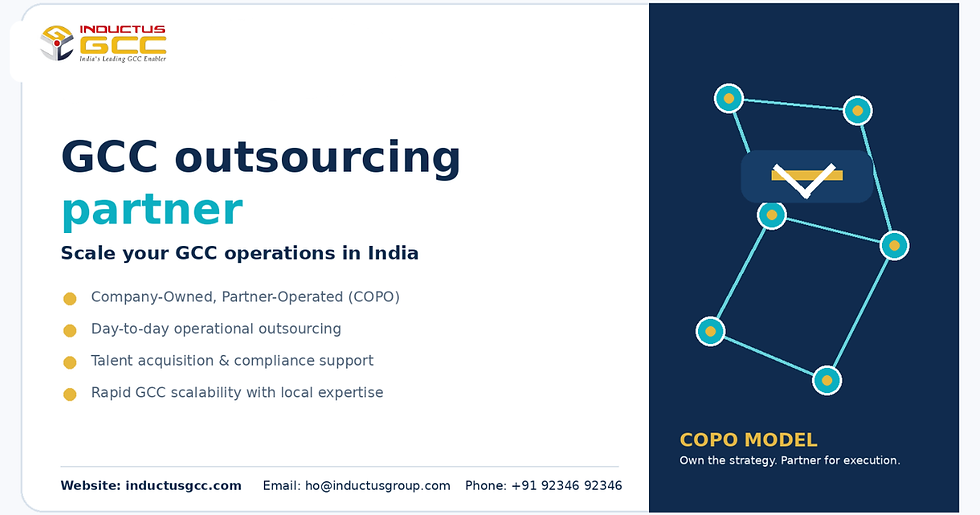
A partner-operated GCC is different. Under the Company-Owned, Partner-Operated (COPO) model, the parent company keeps ownership of the center’s core assets, including intellectual property, technology and strategic direction. The partner manages day-to-day operations such as infrastructure, talent acquisition and compliance. Inductus describes this as a strategic alternative to BPO, closer to a managed service in which the center remains an extension of your own functions.
That distinction changes how you should evaluate the workforce. You are not buying hours of labor. You are building a team that must understand your products, adopt your standards and grow with your mandate, while someone else handles the administration of employing them.
Four Workforce Questions to Settle Before You Sign
1. Who recruits, and to whose standard?
Talent acquisition sits with the partner in a COPO arrangement. That is a real advantage: India’s talent market is large but competitive, and a local partner with existing hiring channels can move faster than a new entrant. Operational readiness can often be reached in as little as 90 days when pre-built infrastructure and teams are in place.
Speed is only useful if the hiring bar is yours. Agree on how roles are defined, who signs off on leadership and technical hires, and how candidates are assessed. Ask to be present at interviews for key roles. A partner that welcomes this is treating the team as yours. A partner that resists is treating it as inventory.
2. Who leads the team day to day?
Every center needs local leadership. Decide early whether the center head and team leads are drawn from the partner’s bench, hired specifically for you, or a mix. Each option has trade-offs. Partner-supplied leaders bring operating experience and can start quickly. Dedicated hires bring stronger alignment with your business but take longer to find.
Whatever you choose, define reporting lines in both directions. Your headquarters needs a clear point of contact, and the local team needs to know whose priorities come first. Confusion here is the most common reason partner-operated centers feel disconnected.
3. How will you keep people?
Attrition is the quiet cost of any offshore team. When people leave, institutional knowledge leaves with them, and replacement hiring resets productivity.
Put retention on the table as a joint responsibility. Ask the partner how it manages compensation against local benchmarks, career paths, recognition and employee engagement. Ask what attrition data it will share and how often. Agree on what happens if attrition crosses an agreed level, such as a retention review or a corrective plan. Because the partner carries the employer relationship, it controls the levers. Your contract should make it accountable for using them well.
4. Who holds the knowledge?
In a partner-operated model, the processes and know-how of your center live in the heads of employees who are on someone else’s payroll. That is manageable, but only if you plan for it.
Require documented standard operating procedures, shared repositories and regular knowledge reviews. Keep ownership of all process documentation, training material and tooling with you, consistent with the principle that the parent retains IP and technology. If you ever change providers or move toward ownership, this documentation is what protects continuity.
Culture Does Not Transfer Automatically
A team can meet every service target and still not feel part of your company. Culture has to be built deliberately across the partner boundary.
Practical steps help. Include the center’s team in global town halls and product briefings. Give them access to the same tools and communication channels as headquarters. Rotate headquarters staff through the center, and bring center leaders to headquarters. Share business context, not only task lists, so the team understands why the work matters.
This is where the “extension of your company” idea is tested. A partner that supports these practices, rather than treating them as outside its scope, is a better fit for a long-term arrangement.
Matching Workforce Control to Your Situation
Different companies want different levels of involvement. A few patterns are common.
You want speed and light involvement. COPO suits this. The partner builds and manages the team while you set strategy and standards. Insist on interview rights for senior roles and a regular people review.
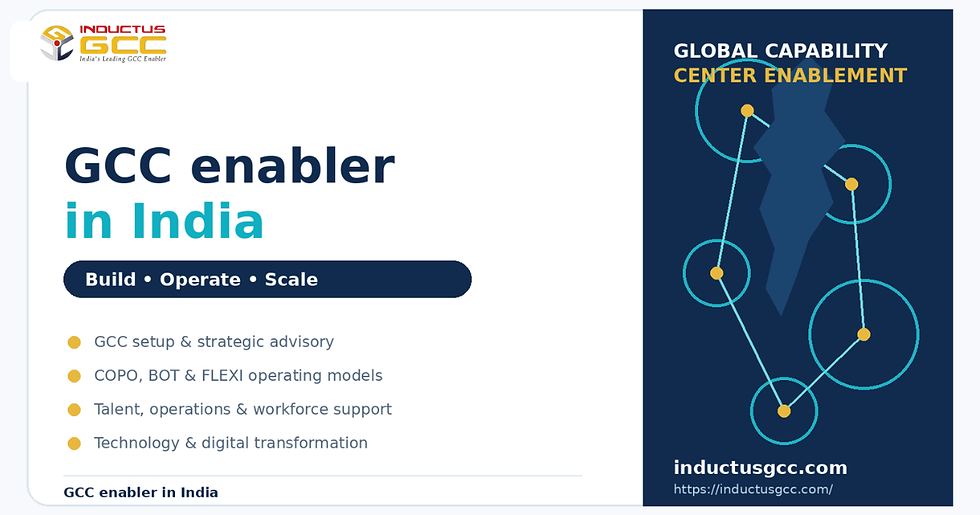
You want to own the team eventually. A Build-Operate-Transfer route may suit better. The partner builds and runs the center, then transfers it to you. Plan the workforce transfer from the start, including how employees will move and how leadership will change.
Your needs are unusual. A flexible model lets you split responsibilities differently, for example keeping leadership hiring in-house while delegating the rest. Define the split in writing.
A good partner will help you choose, not push a single model.
What to Ask in Your Next Partner Meeting
Bring this short list. The answers show how a partner thinks about your people.
How do you recruit for our roles, and where can we intervene?
Who will lead the center day to day, and how are they selected?
What attrition data will you share, and how often?
What is the plan if attrition rises above an agreed level?
How do you document processes, and who owns the documentation?
How will you involve the team in our culture and business updates?
If we later transfer the center to our own ownership, how do people and knowledge move?
The Bottom Line
Cost and compliance are why companies look for a GCC outsourcing partner. People are why the arrangement succeeds or fails. The partner you choose will hire, manage and retain the team that carries your strategy in India.
Treat workforce ownership as a core selection criterion. Settle who hires, who leads, who keeps people and who holds the knowledge, and the rest of the arrangement becomes much easier to manage.
Considering a partner-operated GCC? Talk to the Inductus GCC team about how the COPO model handles hiring, leadership and retention for your center.
Comments