Global Capability Center: The Five Types and How to Match One to Your Purpose

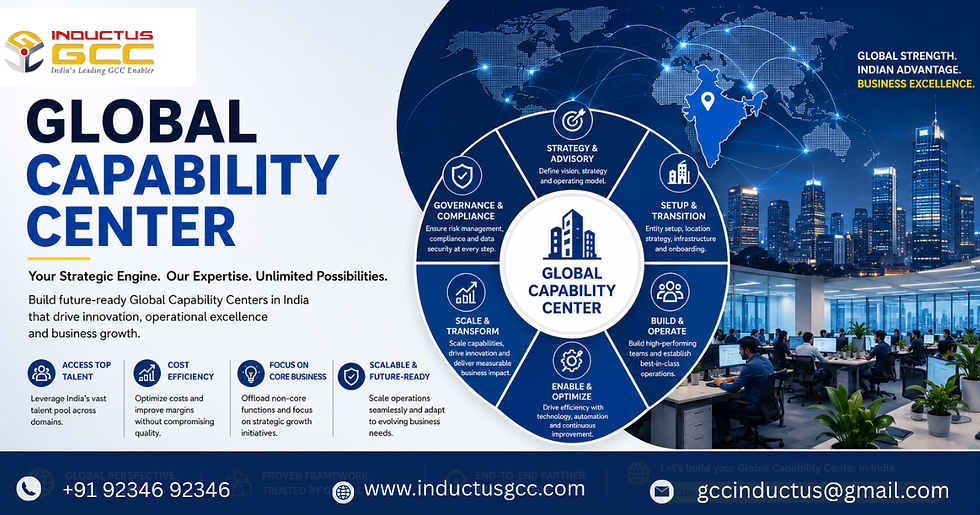
A Global Capability Center (GCC) is a captive center set up by a multinational company to run key functions from another country, and India is the leading location for them. India hosts over 1,800 GCCs, with a market size above $46 billion and more than 50% of the world’s GCCs. The model is shifting from cost-saving back office to innovation-led hub, with growing work in AI and cybersecurity.
“GCC” is an umbrella term, though. Centers differ widely in purpose, structure, and skills. Choosing the right type before you build is one of the most important early decisions. This article explains the five common types and how to match one to your goals.
Why the Type Matters
A GCC built without a clear type tends to drift. Leadership expects innovation, but the team is staffed for transaction processing. Or the reverse: a research function is placed in a structure designed for service delivery.
The type shapes:
Skills and hiring: What roles you recruit
Location: Where talent and infrastructure fit best
Governance: How the center reports into headquarters
Metrics: What success means
Growth path: How the center can evolve
The Five Types of GCC
1. Shared Service Centers
These centers centralize and standardize key functions such as finance, HR, IT, and procurement. Consolidating services improves operational efficiency, reduces cost, and streamlines processes across the parent organization.
Typical work: Payroll, accounts payable, IT support, procurement operations
Strength: Predictable, measurable, and quick to show savings
Watch for: Staying at transaction level and never moving up the value chain
2. R&D Centers
Research and development centers are innovation hubs focused on creating new products, technologies, and processes. They often specialize in fields where the parent organization already has deep expertise.
Typical work: Product engineering, platform development, applied research
Strength: Direct contribution to competitive advantage
Watch for: Need for senior technical leadership and strong IP governance
3. Knowledge Centers
Knowledge centers gather, manage, and share information across the organization, so insights and expertise reach teams in every geography.
Typical work: Research support, analytics, knowledge management, documentation
Strength: Connects global teams and preserves institutional expertise
Watch for: Unclear ownership of outputs if the center is not tied to business decisions
4. Innovation Centers
These centers foster creativity and collaboration. They act as incubators where companies explore, research, and prototype new solutions, and they support strategic initiatives and future growth.
Typical work: Prototyping, pilots, new-product exploration, partnerships with startups and academia
Strength: Builds the pipeline of future offerings
Watch for: Pilots that never reach production without a path into the core business
5. Customer Service Centers
Customer service centers support clients by handling inquiries, complaints, and feedback. They are essential for relationships and customer satisfaction.
Typical work: Support, issue resolution, feedback management
Strength: Scalable, with clear service-level targets
Watch for: Quality drift if training and process standardization are weak
Quick Comparison
Type | Primary Goal | Main Skills | Typical Metric |
Shared service | Efficiency and cost | Process, finance, HR, IT | Cost per transaction, accuracy |
R&D | Innovation and IP | Engineering, research | Products shipped, patents |
Knowledge | Information flow | Analytics, research | Reuse, turnaround |
Innovation | New ideas | Design, prototyping | Pilots launched, adoption |
Customer service | Customer satisfaction | Support, communication | Resolution time, satisfaction |
Matching Type to Purpose
Start with the problem you want the center to solve.
Reduce cost and standardize operations → Shared service center
Build products or technology faster → R&D center
Spread expertise across regions → Knowledge center
Explore new offerings and partnerships → Innovation center
Support customers around the clock → Customer service center
Many companies need more than one. A center can start with one type and add others as it matures.
Types Are Not Fixed
Most GCCs begin as process hubs. Over time, they can evolve into centers for innovation, spotting trends and developing new business practices. A shared service center, for example, may add analytics and then move into product support. Plan for that path at the start so governance, hiring, and infrastructure can grow with it.
Choosing a Service Model
Once the type is clear, pick how the center will be built and run. Inductus GCC offers three models:
BOT (Build-Operate-Transfer): Launch a dedicated GCC with precision, with a transition to full ownership and strong control over processes and data integrity.
COPO (Company-Owned, Partner-Operated): Keep full ownership while the partner operates the center, with a zero-CapEx option, IP security, and pre-built systems for rapid deployment.
FLEXI: Customized services on demand, with no rigid commitments, suited to teams that need to scale up or down.
Different types often favor different models. A fast-scaling customer service center may suit COPO. A strategic R&D center may suit BOT, where eventual full ownership matters.
Steps to Set Up Your GCC
Whatever the type, the setup path follows common steps:
Define your vision: Align the GCC with parent-company strategy and maintain cultural consistency.
Standardize SOPs: Set clear processes for hiring, procurement, and payments.
Choose the right location: Pick a city that fits your strategy and talent needs.
Complete the paperwork: Handle the MoA, Articles of Association, and Directors ID.
Hire flexibly: Use India’s talent pool, with an inclusive culture and flexible work options.
Plan for growth: Build in a path from process hub to innovation center.
Common Mistakes
Starting without a defined type or mandate
Staffing for one type and expecting outcomes of another
Treating the center as a cost project only
Ignoring the growth path
Picking a model before clarifying purpose
Conclusion
A Global Capability Center is not one thing. It is shared services, R&D, knowledge work, innovation, customer service, or a blend. Decide the purpose first, match it to a type, then choose the model and location that support it. That order saves rework and gives the center a clear path to grow.
Comments