How to Structure a Contract with a GCC Outsourcing Partner in India

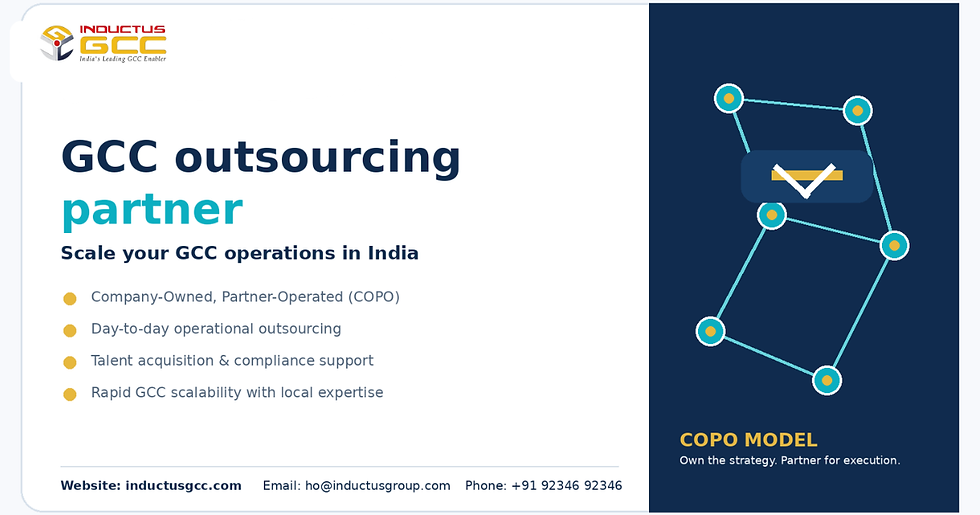
In a Company-Owned, Partner-Operated (COPO) arrangement, you keep ownership of the center’s core assets, including IP, technology, and strategic direction. The partner runs day-to-day operations: infrastructure, talent acquisition, and compliance. That split only works if the agreement spells out who is responsible for what, how performance is measured, and how the relationship can change over time.
This article covers the contract elements that matter most.
Why the Contract Matters More Than the Pitch
A sales presentation describes intent. A contract defines obligations. With a GCC partner, the stakes are higher than with a typical vendor, because the partner manages the people, systems, and compliance that carry your business processes.
COPO also differs from traditional Business Process Outsourcing (BPO). In BPO, the provider often owns the delivery assets. In COPO, you keep control of IP and strategy while the partner handles operational complexity. The contract should reflect that difference at every clause.
The Six Contract Building Blocks
1. Scope of Services
Be specific about what the partner operates. Typical scope areas include:
Infrastructure management
Talent acquisition and onboarding
Compliance and regulatory management
Offshore team operations
Support for Shared Services Centers or Digital Transformation Hubs
Tip: List what is out of scope too. Gaps in scope are the most common source of disputes.
2. Ownership and IP
The COPO model rests on your ownership of core assets. Make that explicit:
IP created by the center belongs to the parent company
Technology, tools, and data remain your property
Strategic direction stays with your leadership
Any partner-owned tools or templates are listed, with usage rights defined
3. Pricing Structure
Pricing should match how you want to scale. Common structures include:
Pricing Approach | Best For | Watch Out For |
Cost plus fixed fee | Transparency and predictable margin | Needs open-book reporting |
Per-head or per-seat | Steady, headcount-driven teams | Less incentive for efficiency |
Fixed price per outcome | Well-defined processes | Requires precise scope |
Hybrid | Mixed workloads | More to administer |
COPO is designed to reduce large upfront capital investment and to handle fluctuating demand. The pricing model should preserve that flexibility, not undermine it with rigid minimums.
4. Service Levels and Performance Metrics
Agree on measurable service levels before go-live. Cover:
Quality and accuracy targets
Turnaround times
Hiring speed and attrition
Compliance and audit results
Reporting cadence and escalation paths
Link metrics to consequences. Credits, remediation plans, and review triggers give the numbers weight.
5. Data, Security, and Compliance
The partner takes on responsibility for compliance and regulatory management. Confirm in writing:
Which regulations and standards the partner must meet
Data handling, access control, and breach notification duties
Audit rights for you and your regulators
Subcontractor rules and flow-down obligations
6. Governance and Change Control
A GCC changes over time. Build a process for it:
Regular operational and executive reviews
A defined change-request process for scope, headcount, and priorities
Named relationship owners on both sides
Escalation steps for disputes
Rights That Protect You Over Time
The strongest agreements plan for change, not only for steady running. Include:
Scale-up and scale-down terms: Clear rules on adding or reducing capacity without penalty beyond a defined notice
Step-in rights: The ability to intervene or bring in support if performance fails
Transition and exit provisions: Knowledge transfer, documentation, and orderly handover of teams, systems, and records
Key-person provisions: Continuity for critical leadership and subject-matter roles
Even if you never use these rights, having them changes how the partner behaves.
Speed to Operation
COPO can accelerate time to market. The Inductus COPO model deploys pre-built, mirrored systems for rapid launch, and operational readiness can be achieved in as little as 90 days. Contract negotiation should not erase that advantage. Agree on the core structure early, and use a defined change process for details that can follow.
Contract Red Flags
Vague scope with “other services as required”
Ownership of IP or data left unclear
Pricing that penalizes scale-down
No audit or reporting rights
No exit or transition plan
Compliance duties stated generally, with no named standards
Heavy dependence on a few unnamed individuals
A Pre-Signing Checklist
Scope and exclusions are listed in detail
IP, technology, and data ownership are explicit
Pricing model matches your growth plan
Service levels and consequences are defined
Compliance, audit, and security duties are named
Governance cadence and escalation are agreed
Scale, step-in, and exit rights are in place
Legal and finance teams have reviewed the terms
COPO and Other Models
COPO is one option. If your goal is eventual full operational ownership, a Build-Operate-Transfer (BOT) arrangement may fit better, since the partner builds and runs the center for a set period and then transfers it to you. A flexible structure such as Inductus’s Flexi model can adapt to changing needs. The contract approach differs by model, so match the terms to the structure you choose.
Conclusion
The right GCC outsourcing partner is one that works within a clear, enforceable agreement. Define scope, protect ownership, align pricing with how you scale, measure performance, and secure the rights to change course. Get those right and the partnership supports your strategy for years.

Comments