What Is a GCC Enabler in India, and What Should It Actually Do?

India now hosts more than 2,100 Global Capability Centers. They make up over half of the world’s GCC footprint, in an industry worth more than $46 billion and employing over 2.4 million professionals. Behind most of these centers is a partner that guided the company from first idea to working operation. That partner is the GCC enabler.
Before you pick one, you need a clear picture of what an enabler is and what it should deliver. This article explains the role, the stages it covers, and how it differs from the other advisors you may meet.
What Is a GCC Enabler?
A GCC enabler is a specialist partner that helps a global enterprise plan, build, operate, and scale a captive center in India. It covers strategy, legal setup, talent, technology, and the operating model. It is accountable for the center becoming functional, not only for advice delivered.
The label matters because “GCC” is used loosely. Depending on its maturity, a center may be an Offshore Development Center (ODC) focused on technology build, a Shared Services Center (SSC) centralizing finance, HR, or procurement, or a Global Business Services (GBS) hub combining several functions. A good enabler helps you decide which identity your center should grow into, and plans for the next one.
Enabler vs. Consultant vs. Vendor
These roles overlap in marketing but differ in practice.
Role | Core Output | Accountability |
Strategy consultant | Recommendations and a business case | Ends at advice |
Staffing or real-estate vendor | Hires or office space | Ends at the transaction |
GCC enabler | A working, compliant, staffed center | Spans setup through scale |
A consultant can tell you where to build. A vendor can fill a seat. An enabler connects the pieces so legal, hiring, technology, and governance move together.
The Enabler’s Journey: Four Stages
A credible enabler works through a defined lifecycle. Inductus structures its work as Discover, Design, Build, and Scale.
Discover
The goal is to define why the center exists and what it will own. Typical work includes:
Reviewing current operating models and cost structures
Choosing which functions to move, based on control, cost, and dependencies
Assessing regulatory, tax, and data-governance requirements
Selecting a location based on talent, infrastructure, and cost
Design
The blueprint becomes an operating structure:
Legal entity structure and compliance framework
Governance, reporting lines, and decision rights
Organization design and workforce composition
Compensation aligned to local benchmarks
Infrastructure and technology architecture
Build
The center becomes operational:
Incorporation and regulatory registrations, including FDI and SEZ approvals where relevant
Office and enterprise technology deployment
Leadership hiring and phased onboarding
Transfer of processes and knowledge from global teams
Compliance, audit, and reporting mechanisms
Scale
After launch, the center takes on more scope, more complex work, and greater ownership. This is where many centers stall if the enabler’s involvement ends at go-live.
Why the Enabler Choice Shapes the Outcome
India’s GCC story is shifting from cost arbitrage to value arbitrage. Centers increasingly own AI, product engineering, and R&D mandates. A center built only for cost savings struggles to take on that work later.
An enabler influences this in three ways:
Model fit. The wrong ownership model can lock in the wrong control and cost balance.
Execution speed. Parallel work on legal, hiring, and technology shortens the timeline compared with sequential handoffs.
Strategic headroom. A center designed with growth in mind can move from process execution to innovation.
Ownership Models an Enabler Should Offer
No single model suits every company. Look for an enabler that offers several and recommends one on merit.
BOT (Build-Operate-Transfer): The partner builds and runs the center, then transfers it to you.
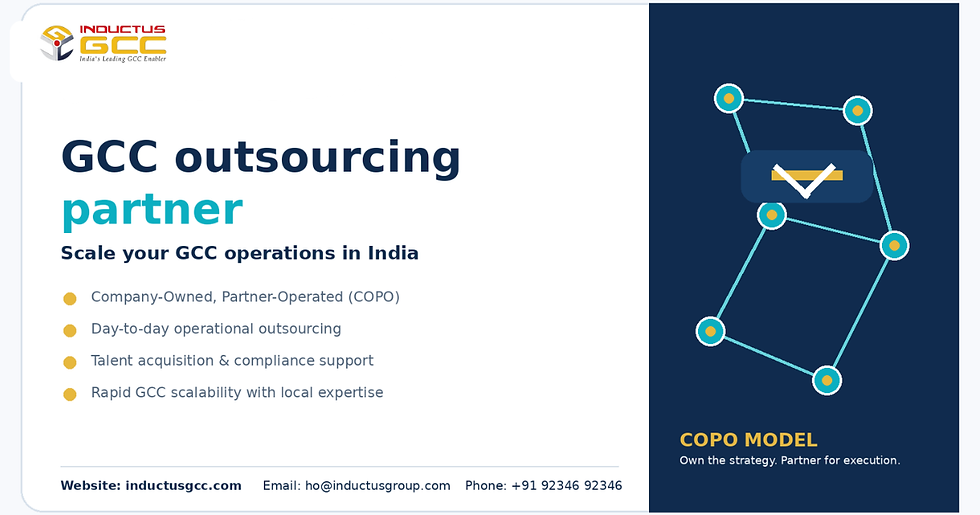
COPO (Company-Owned, Partner-Operated): You own the brand and systems. The partner handles daily operations.
Flexi: A flexible structure adjusted to how your business wants to operate.
Some enablers add a Digital Twin capability, which gives real-time operational sync across locations without time-zone lag.
One Umbrella or Many Vendors?
A GCC touches legal, HR, IT, trade, and compliance. Coordinating separate providers for each adds handoffs, and handoffs are where scope gaps appear.
Inductus presents an umbrella model that brings these under one roof:
GCC and ODC setup
IT and technology consulting
Legal entity setup and compliance support
Talent acquisition and workforce design
Global trade and export support
Legal process outsourcing
Whether one umbrella or a partner network suits you depends on your internal team. If your organization lacks capacity to coordinate several vendors, a single accountable partner reduces risk.
Evidence to Look For
A strong enabler can show proof beyond its own website.
Track record: Inductus was founded in 2007 and states it has served 300+ clients over 17+ years. It has 1,500+ professionals and a footprint across the USA, UK, UAE, Germany, Japan, South Korea, Australia, and Luxembourg.
Independent citation: Forbes India cited the Inductus 2024 annual report in its coverage of India’s shift from IT hub to GCC hub, noting that roughly 60 percent of the top 500 global companies have set up GCCs in India.
Industry convening: Inductus hosted the inaugural Global GCC Summit in November 2025 at the Hyatt Regency, New Delhi, under the banner “Advantage India.”
Original research: It has published a compendium on the sector’s journey from 1985 to 2040.
Ask any enabler for similar evidence and check it independently.
Questions to Ask Before You Sign
Which ownership model do you recommend for us, and what are the trade-offs?
What does each stage deliver, and who signs it off?
Which parts of the work do you handle directly, and which do you subcontract?
How do you handle entity setup and compliance before hiring begins?
What happens after go-live? What does the Scale stage include?
What recent research or independent coverage can you share?
Common Mistakes When Choosing an Enabler
Choosing on cost alone and ignoring scope gaps
Accepting one model without comparing alternatives
Treating compliance as a late-stage task
Assuming go-live is the finish line
Skipping independent verification of claims
Conclusion
A GCC enabler is the partner that turns a decision into a working, compliant, scalable center. Choose one by looking at lifecycle coverage, model flexibility, and verifiable evidence, and by what it still delivers after launch. Done well, the GCC becomes a real extension of headquarters rather than another back office.
Comments